
Overview
Reducing acquisition costs and improving conversion across multiple European markets.
A Swiss EdTech platform operating across 7 European markets was struggling with high acquisition costs. Cost per sign-up and Cost per Purchase were both too high, the tracking infrastructure was unreliable, and the Google Ads account structure was working against the algorithm rather than with it.
The challenge was to take over the accounts, rebuild them from the ground up, and make paid acquisition profitable across all markets.
Initial Situation
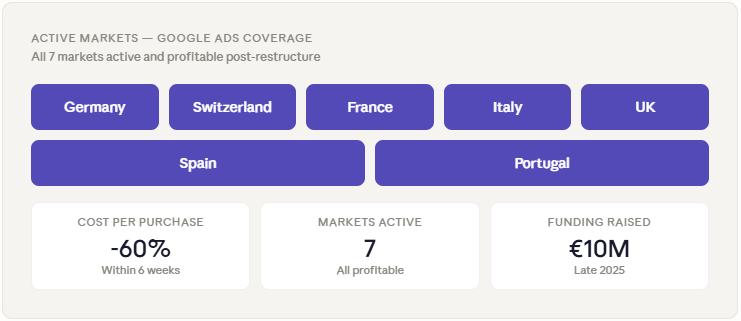
The platform had Google Ads activity running across Germany, Switzerland, France, Italy, the UK, Spain, and Portugal, but the account structure was too granular to generate sufficient conversion data for the algorithm to optimise effectively. Tracking was incomplete, meaning decisions were being made on unreliable data. Cost per Purchase was too high relative to the business model, and the payment page was not converting at the rate it should. No market-specific optimisation was in place despite significant differences in performance across regions.
Objectives
- Reduce Cost per Lead and Cost per Purchase across all markets
- Fix tracking to capture more accurate and detailed conversion data
- Improve payment page conversion rate
- Restructure campaigns to work more effectively with Google’s algorithm
Approach
The engagement started with a full audit across all 7 market accounts. Tracking was rebuilt to capture more granular data at every stage of the funnel. On the payment page, conversion rate improvements were implemented to reduce drop-off at the most critical step.
The campaign restructure followed a clear principle: less is more. Fewer campaigns, fewer ad groups, and fewer keywords per ad group meant more data flowing through each campaign, which trained the algorithm faster and more accurately. Rather than pushing for Target ROAS bidding immediately, a step back was taken to optimise for Cost per Sale first, as conversion volumes were too low to support ROAS-based strategies reliably. Soft conversions were introduced as a primary conversion signal in the early phase, specifically payment page interactions, which carried high intent and generated enough data for the algorithm to learn from.
Completely new landing pages were built in collaboration with the client. A high-quality translation process was implemented across all 7 markets using a combination of AI tools and local freelancers from each country to ensure accuracy and relevance. Campaigns were then relaunched with the new structure, new landing pages, and improved tracking in place.
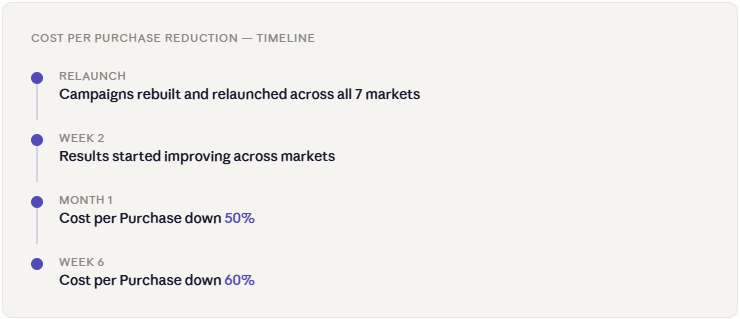
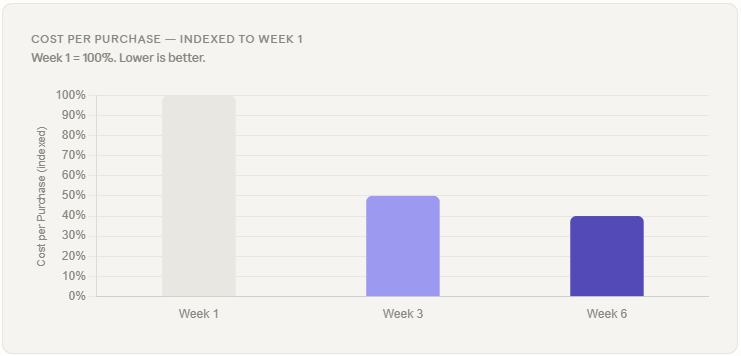
Within two weeks results began to improve. Within a month Cost per Purchase was down 50%. By week six the accounts had achieved 60% lower Cost per Purchase across the board. Markets that adapted faster to the new structure were scaled aggressively, while slower-performing markets continued to receive targeted optimisation.
Results
- Cost per Purchase reduced by 60% within 6 weeks of relaunch
- Cost per Purchase down 50% within the first month
- Improved tracking across all 7 markets providing reliable decision-making data
- Payment page conversion rate improved
- Campaigns active and profitable across Germany, Switzerland, France, Italy, UK, Spain, and Portugal
- Client secured €10 million in funding in late 2025
Key Learnings
- Over-segmented Google Ads accounts starve the algorithm of data. Consolidation consistently outperforms granularity when conversion volumes are low
- Tracking quality determines the quality of every decision made downstream. Fixing it first is non-negotiable
- Bidding strategy should match the data available, not the ideal outcome. Stepping back from Target ROAS to optimise for Cost per Sale produced better results despite being a less sophisticated strategy on paper
- Market-specific performance will always vary. Scaling what works fast and optimising what does not is more effective than applying a single strategy uniformly across all markets
Optimizing an existing ad account starts at the core - The campaign structure and the data. After that, targeting and landing pages play a significant role, together with all the bits and pieces that have to work together.