
Overview
Improving campaign efficiency, funnel visibility, and digital acquisition for one of Germany’s largest insurance companies.
R+V is one of Germany’s largest insurers, with over 9 million customers, more than €21 billion in annual premium income, and a workforce of over 15,000 employees. Despite its scale, even a business of this size can face structural challenges in digital marketing. The brief covered three areas: improve the efficiency of existing Google Ads activity, build a deeper understanding of digital customer journeys through data infrastructure, and launch affiliate marketing at scale through the leading financial affiliate network in the German market.
Initial Situation
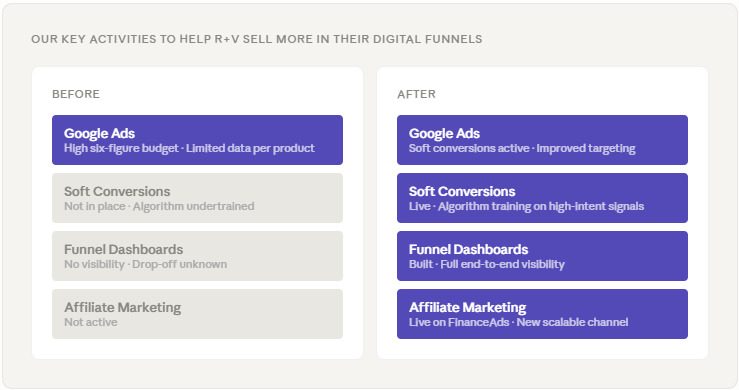
R+V was running high six-figure monthly budgets across Google Ads, but the product portfolio created a structural challenge. With spend distributed across multiple insurance products, the budget per product was in some cases not sufficient to generate enough sales data to train Google’s algorithm effectively. The result was suboptimal targeting, as the algorithm lacked the data needed to identify and reach the ideal customer profile for each product. Alongside this, the business lacked the funnel visualisation infrastructure needed to analyse digital journeys at a granular level. Affiliate marketing had not yet been introduced despite clear potential in the financial services vertical.
Objectives
- Improve Google Ads targeting efficiency across the product portfolio
- Introduce soft conversions to provide the algorithm with richer training data
- Build funnel dashboards to enable deeper analysis of digital customer journeys
- Launch and scale an affiliate marketing programme on FinanceAds
Approach
The core strategic challenge on Google Ads was a data problem. When conversion volumes per product are too low, the algorithm cannot build an accurate picture of who converts. The solution was to introduce soft conversions at key stages of the funnel.
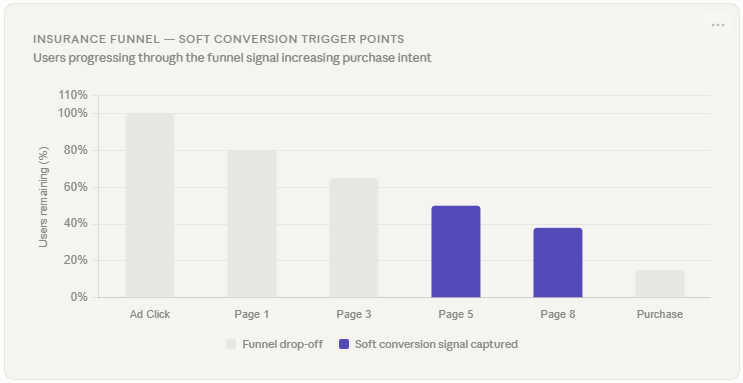
Insurance products at R+V typically involve multi-step questionnaire funnels. A user who progresses through five to ten pages of a questionnaire demonstrates strong purchase intent, as the effort involved filters out low-intent users. By tracking these funnel interactions as soft conversion signals and feeding them into the algorithm, the targeting model was given significantly more data to work with. This allowed the algorithm to identify and reach users who closely resembled those with genuine purchase intent, even before a sale was completed. The result was improved targeting efficiency and, over time, higher conversion rates.
Soft conversion tracking was also implemented as a permanent data layer across all funnels, regardless of whether it was used directly for bidding purposes. This provided a clear view of exactly where users were dropping off in each digital journey. These data points were then used to build funnel dashboards, giving R+V the ability to analyse all their digital journeys at a much deeper level and make informed decisions about where to optimise.
On the affiliate side, R+V’s affiliate programme was set up and launched on FinanceAds, the largest affiliate network for the financial industry in the German market. This opened a new acquisition channel operating on a performance basis, adding measurable, scalable reach beyond paid search.
Results
- Soft conversions introduced across the product portfolio, providing the algorithm with richer and more actionable training data
- Google Ads targeting efficiency improved through better algorithm training
- Conversion rates improved over time as a result of more accurate audience targeting
- Funnel dashboards built, giving R+V full visibility of digital customer journeys end to end
- Affiliate programme launched on FinanceAds, establishing a new scalable acquisition channel in the financial services vertical
Key Learnings
- Low conversion volumes per product do not mean Google Ads don’t work. Soft conversions can solve the data problem by giving the algorithm high-intent signals it can learn from effectively
- Tracking soft conversions across the funnel is valuable regardless of whether they are used for bidding. The drop-off data alone is a critical input for optimisation decisions
- Funnel dashboards are not meant to be a reporting tool. They are a decision-making infrastructure. Businesses that can see exactly where users drop off can act on it and focus their attention on the right parts of the funnel.
- Affiliate marketing in financial services is a high-value, performance-based channel that large insurers are often late to activate. Setting it up correctly from the start on the right network makes scaling significantly easier
Even a company that spends high six-figure budgets on Google Ads can suffer from a lack of data. However, there are proven solutions for both small and large companies to overcome this challenge.