
Overview
From third-party dependency to full data ownership: a 9-month tracking and visualisation project for a modern German insurance company
Die Bayerische is a Bavarian insurance company with close to 1,000 employees. Modern in its approach and well ahead of many peers in digital, the business had already built well-designed digital journeys. The missing piece was data ownership. The business was relying on third-party tools to track and visualise its data and wanted to change that. The goal was to build an in-house data analysis tool capable of replacing Google Analytics 4 entirely.
Initial Situation
- Web tracking and data visualisation fully dependent on third-party tools
- No in-house infrastructure to capture, store, or analyse website and funnel data
- Google Analytics 4 in use but the business wanted to discontinue reliance on it
- No structured dashboards or reports built around the most business-critical data points
Objectives
- Capture all relevant data from the website and digital journeys
- Build an in-house tool to visualise that data
- Build dashboards and reports to surface the most important insights
- Discontinue Google Analytics 4 by the end of the project
Approach
The engagement involved three parties working together: the Die Bayerische marketing team, an agency responsible for building the product, and our team acting as consultants and project managers. Our role was to guide the direction of the build, ensure the right features were prioritised, and keep the project on track toward the end goal.
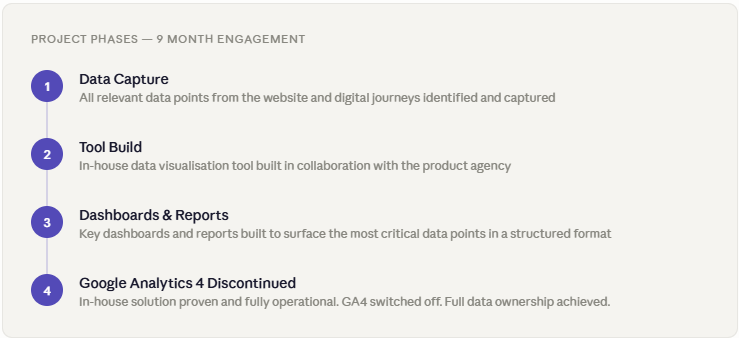
The project was structured in four steps. First, all relevant data points from the website and digital journeys were identified and captured. Second, the tool to visualise that data was built. Third, dashboards and reports were developed to present the most important data in a structured, actionable format, covering the insights that Google Analytics had provided and going further where possible. Fourth, once the in-house solution was proven to cover everything needed, Google Analytics 4 was discontinued.
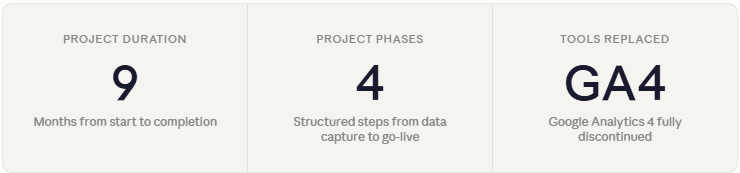
The project ran for nine months. By the end of it, Die Bayerische had full ownership of their web tracking and data visualisation, with no dependency on third-party tools.
Results
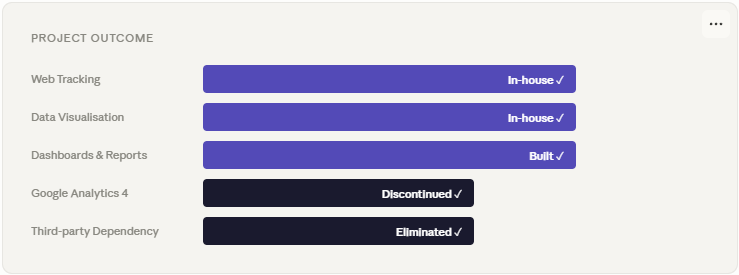
- All web tracking and data visualisation brought fully in-house
- In-house data analysis tool built and operational
- Dashboards and reports covering all key data points delivered
- Google Analytics 4 successfully discontinued
- Die Bayerische now owns and controls its full digital data infrastructure
Key Learnings
- Data ownership is a strategic decision, not just a technical one. Businesses that control their own data are not dependent on the roadmaps or terms of third-party platforms
- Projects like this require clear scope and structured phases. Trying to build everything at once without a step-by-step approach creates risk
- The consultant role in a multi-party project is as important as the build itself. Without clear guidance on what to build and why, agencies can deliver the wrong thing correctly
- Tracking and data work is increasingly central to what we do. Projects like this expand the team’s capability in ways that benefit every client we work with
Most businesses track their data through tools they do not own. When those tools change their terms, their pricing, or their features, the business has no choice but to follow. Helping a client take that dependency away was an interesting and exciting project to be part of.